
You can sign up for Medicare before 65.
Medicare is the federal health insurance program for people who have turned 65, or in other extenuating circumstances such as younger people with certain disabilities, and those with failing kidneys. However, there are situations that will let you qualify for Medicare before 65.
What are some of the conditions that would allow you to qualify or apply for Medicare before you turn 65?
1. End-stage renal disease
Those who suffer from end-stage renal disease are typically eligible for Medicare regardless of age. In order to qualify, your kidneys must no longer work, and you must need regular dialysis or have had a kidney transplant. In addition, you must have a work history that’s long enough to qualify under Social Security, the Railroad Retirement Board program, or as a government employee. Alternatively, if you are the spouse or dependent child of a worker who has a long enough work history, then you can use that worker’s record as your basis to claim Medicare benefits.
Medicare benefits for those with end-stage renal disease last until 12 months after they stop dialysis treatments or 36 months after having a kidney transplant. However, coverage is extended if they restart dialysis or get a kidney transplant within 12 months of stopping dialysis or within 36 months of a previous kidney transplant.
2. Amyotrophic lateral sclerosis (Lou Gehrig’s disease)
Those who suffer from amyotrophic lateral sclerosis, better known as Lou Gehrig’s disease, can qualify for Medicare benefits. For this disease, Medicare coverage is linked to eligibility for Social Security disability benefits. Once you’ve started receiving disability payments from Social Security or the Railroad Retirement Board, then you can get Medicare benefits in that same month.
Until July 2001, ALS sufferers had to follow the same rules that those with disabilities did. As you’ll see below, that included a waiting period before Medicare was available. However, the law change created this exception for ALS that allows benefits to kick in right away.
3. General illnesses, injuries, or disabilities
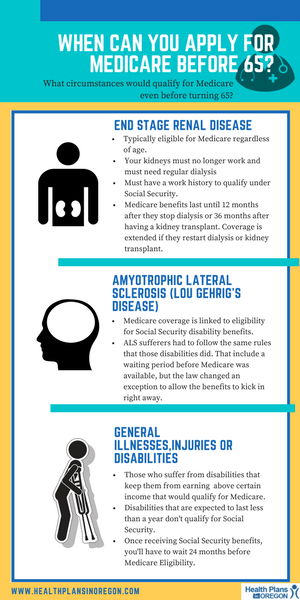
Those who have severe illnesses, injuries, or disabilities that keep them from earnings above certain income thresholds can qualify for Medicare. This is if they meet the standards for Social Security disability benefits. In general, that requires that the disability be long term in nature and that you not be able to do the work you did before or adjust to other types of work because of your medical condition. Disabilities that are expected to last less than a year don’t qualify for Social Security and therefore don’t trigger early Medicare eligibility.
Once you’ve started receiving Social Security disability benefits, you’ll have to wait 24 months before you get Medicare eligibility. However, once you start getting Medicare, you can stay on the program even if you go back to work as long as you are still medically disabled.
Do you have to sign up for Medicare?
It’s important to understand that being eligible for Medicare doesn’t mean that you have to take it. In general, if you have other coverage through group health insurance, you can keep that coverage. Then, if you later lose that coverage, you can typically turn to Medicare for benefits.
In addition, you can usually sign up for just Medicare Part A if you want, leaving Part B until later. Again, that’s a move that can save money. This is because Part A benefits typically require no premium payment while Part B does charge monthly premiums.
